
Gender-based violence also shapes the migration experiences of many Latin American women in Europe. Far from their home countries, and often without family networks, legal documents, or fluency in the local language, many migrant women face violence in silence and isolation. In response to this reality, they have begun building their own networks of care and support.
These networks, created by the very women who have needed them, extend across the five countries mapped in this investigation: Spain, France, Germany, Belgium, and the United Kingdom. Through them, bonds of support and survival are formed — spaces for practical advice, listening, and solidarity — so that many more women can say: I am not alone, I am well supported. Some networks emerge through organisations or digital communities; others grow out of everyday encounters, such as classes, beauty salons, or informal gatherings. In many cases, these spaces become the only bridge to systems of assistance and protection.
The investigation also reveals a structural problem: the lack of data on migrant women who are victims of gender-based violence in several European countries. The absence of disaggregated statistics renders the real impact of this violence on Latin American migrant communities largely invisible and makes it more difficult to design adequate public policies.
In the face of this lack of protection, migrant women continue organising among themselves. Through living, self-managed, and solidarity-based networks, they share information, emotional support, and strategies to survive displacement and leave violent situations behind. In response to invisibility, they build community and collective resistance.
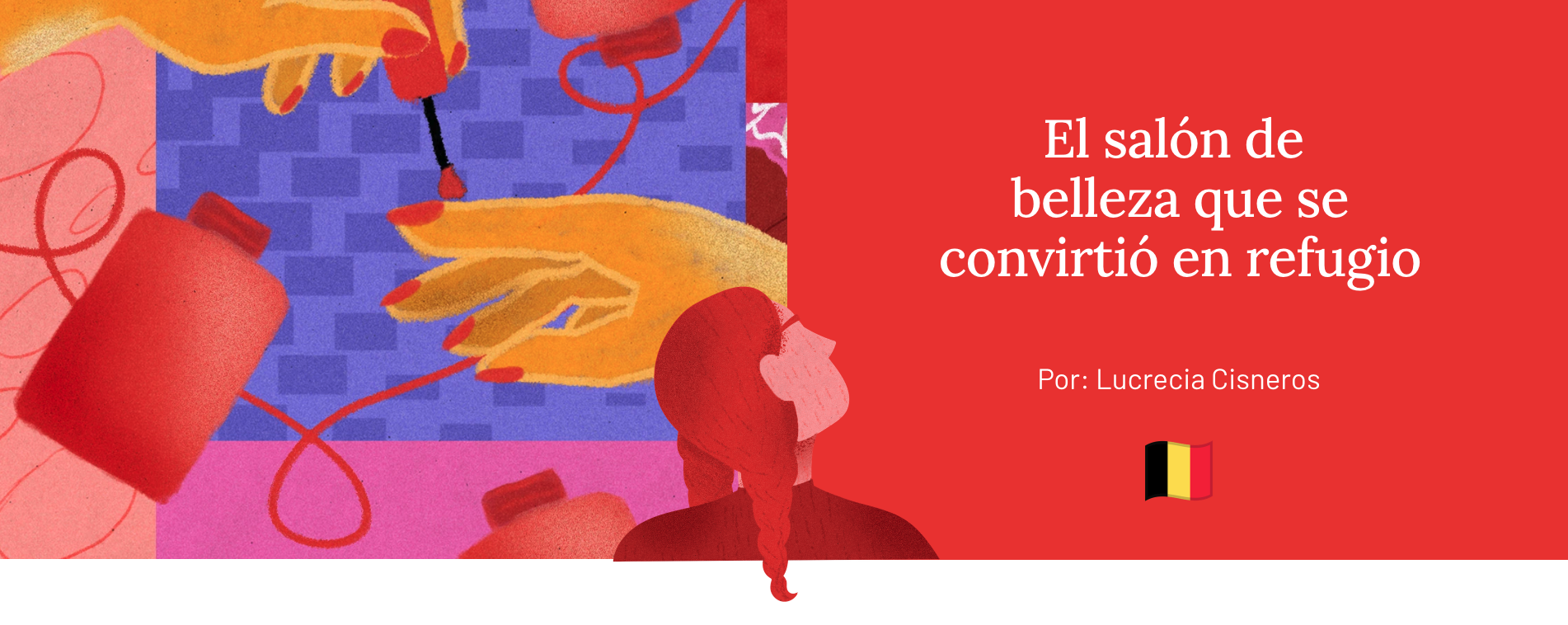
The Beauty Salon That Became a Refuge
By Lucrecia Cisneros RincónShort summary.This chapter tells the story of Mariana, a young Venezuelan woman who migrated to Belgium in search of a new life with a partner she met online. What began as an idealised love story soon turned into an environment of control, humiliation, isolation, and psychological violence inside the home she shared with her partner and his family.
Far from her family, without financial independence, and unfamiliar with the Belgian system and local languages, Mariana gradually lost her autonomy. Insults, control over her movements, social isolation, and normalised abuse shaped her life for years. Meanwhile, back in Venezuela, her mother and sister sensed that something was wrong and eventually migrated to Brussels themselves in an attempt to help her.
The turning point came through an unexpected network: a small Latin American beauty salon in Schaerbeek. There, Mariana found people willing to listen, work opportunities, affection, and a community of migrant women who understood her experience without requiring explanations. This informal network became a space of care and survival, allowing her to regain part of her emotional and financial independence.
Although leaving her abuser’s home did not automatically solve her situation — Mariana continued to face precariousness, fear, and housing instability — the networks built among migrant women continued to offer constant support. Her story also highlights the difficulties migrant women in irregular situations face when trying to access institutional protection, report violence, or defend custody of their children.
Despite the uncertainty and open wounds, Mariana continues rebuilding her life alongside her daughter. The beauty salon, her co-workers, her mother, and other migrant women remain part of her everyday support system. More than an individual story, this chapter shows how networks created by women can become spaces of refuge, resistance, and rebuilding in the face of violence and displacement.
This investigation was made possible through the Cross-Border Collaboration Grant of the Collaborative and Investigative Journalism Initiative (CIJI), coordinated by Free Press Unlimited. It was carried out by a group of Latin American journalists migrants currently living across Germany, Spain, Belgium, France, and the United Kingdom.